Course Series: Shop Foreman Transformation System 101

- Description
- Curriculum
- FAQ
- Notice
- Reviews
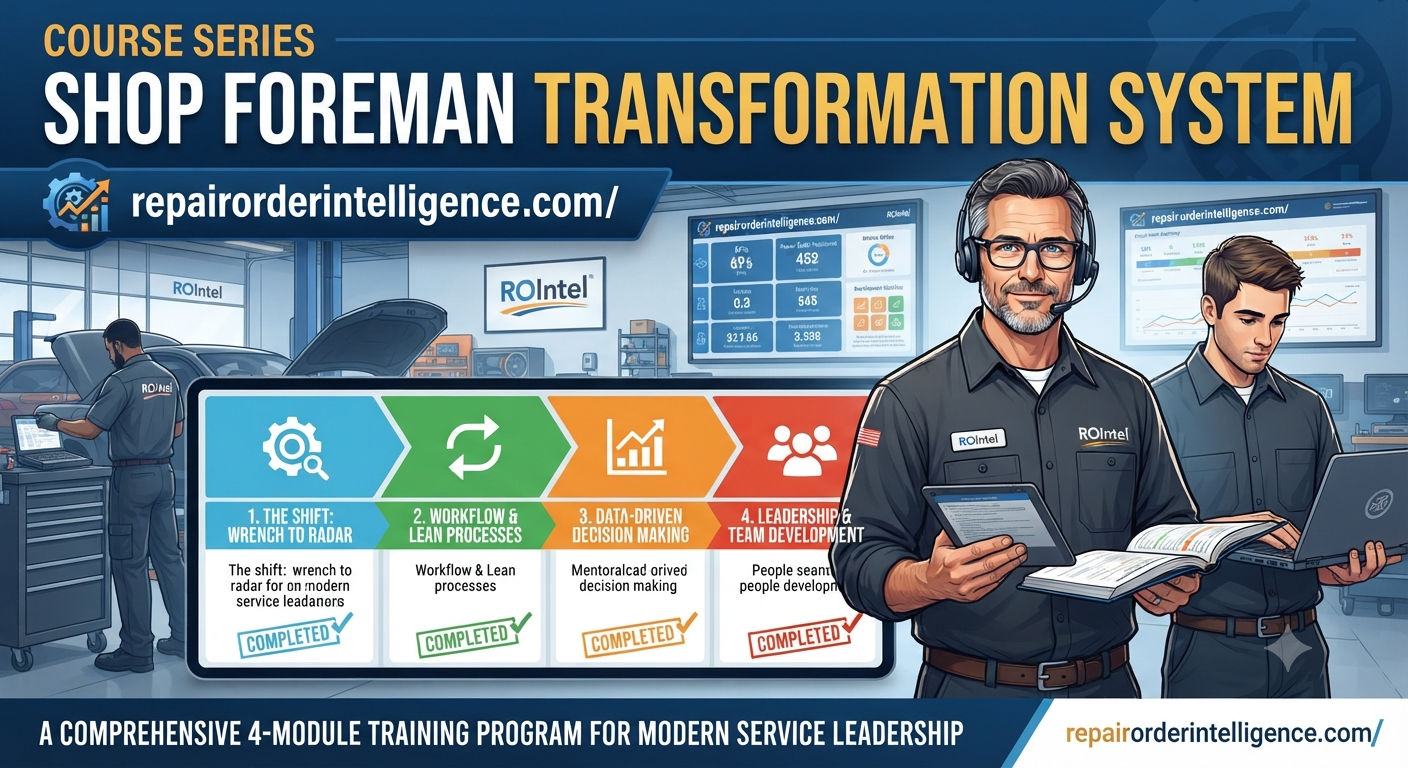
repairorderintelligence.com/
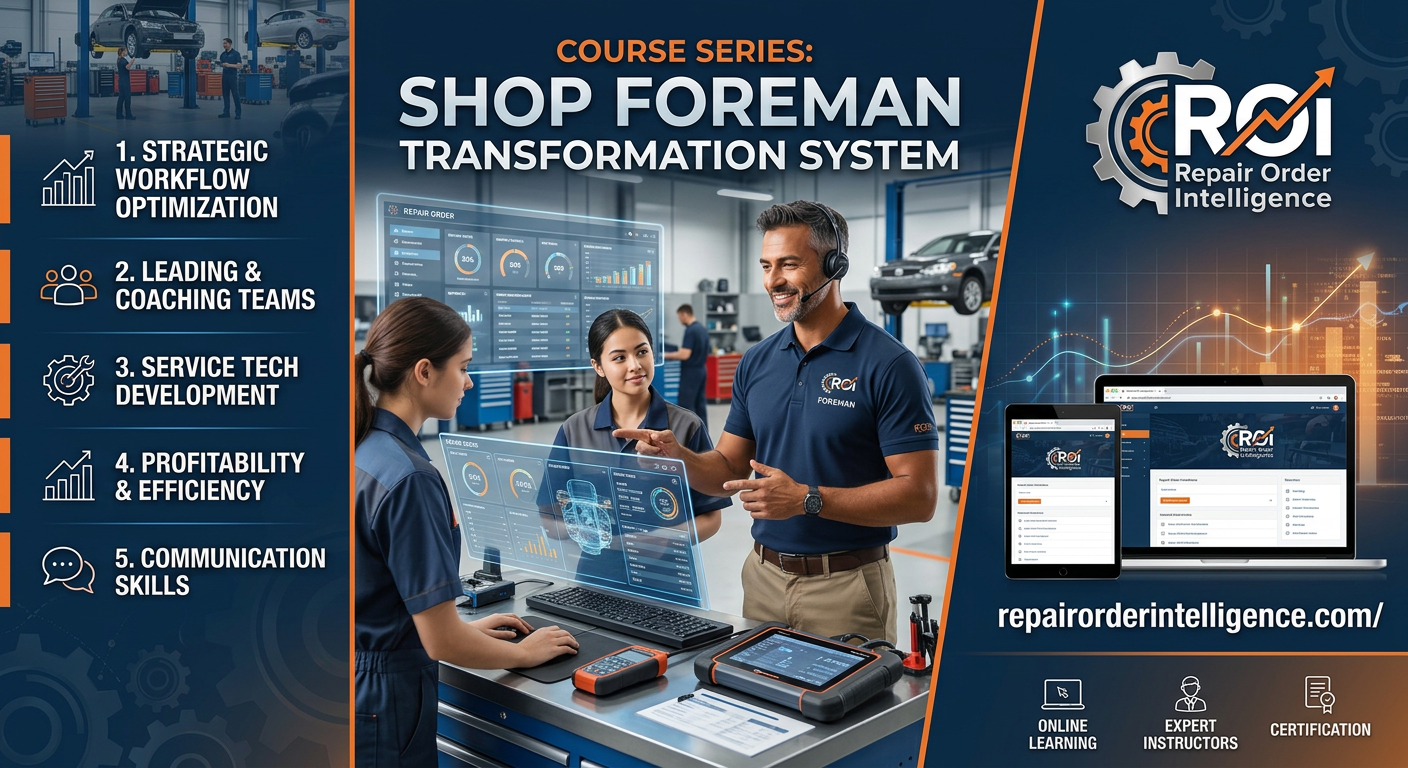
Shop Foreman Transformation System
Courses 1–10 Overview
🧭 PROGRAM OVERVIEW
The Shop Foreman Transformation System is a 10-course operational training series designed to retrain how a foreman thinks, not just what they do.
This is not a technical repair program.
It is a shop flow and control system curriculum built to transform experienced technicians into true operational leaders responsible for efficiency, throughput, and stability inside the service department.
Most foremen are promoted because they were excellent technicians.
This program exists because that promotion does not automatically create operational leadership.
⚠️ THE CORE PROBLEM THIS PROGRAM SOLVES
In most dealerships:
- Foremen continue operating like technicians
- Dispatch is treated as a queue instead of a system
- Work is managed reactively instead of structurally
- “Busy” is mistaken for “efficient”
- Bottlenecks are solved manually instead of systemically
The result is constant interruption, uneven workflow, technician dependency, and lost efficiency hidden inside normal day-to-day activity.
This program corrects that at the source.
🎯 WHAT THIS TRAINING BUILDS
By completing all 10 courses, participants develop the ability to:
- Think in systems instead of individual repair orders
- Identify and eliminate flow collapse points
- Control dispatch as a decision engine
- Reduce technician dependency on leadership intervention
- Stabilize shop throughput without increasing effort
- Separate visible activity from real operational flow
- Build predictable, repeatable shop performance
🧠 COURSE STRUCTURE (1–10)
Each course builds a progressive shift in thinking:
COURSE 1: Identity Shift
You are no longer a technician—you are a flow operator.
COURSE 2: Flow Collapse Points
Work does not fail randomly—it stops in predictable system locations.
COURSE 3: Dispatch Control Systems
Dispatch is not a queue—it is the central decision engine of the shop.
COURSE 4: Interruptions & Hidden Time Loss
Most inefficiency is invisible and created by constant workflow disruption.
COURSE 5: Technician Dependency Loops
How foreman involvement unintentionally reduces technician autonomy.
COURSE 6: Shop Communication Friction
How communication breakdowns silently destroy throughput.
COURSE 7: Intake Structure & First Decision Control
Why most delays begin before work even starts.
COURSE 8: Mid-Job Flow Stabilization
How to prevent stalled repairs without direct intervention.
COURSE 9: Completion & Delivery Systems
Why finished work often becomes hidden inventory.
COURSE 10: Operating as a Complete System Controller
How to run the shop as a predictable, self-stabilizing system.
⚙️ HOW THIS PROGRAM IS DIFFERENT
This is not a “tips and tricks” training.
It does not focus on:
- scripts
- motivational leadership
- generic efficiency advice
- technical repair instruction
Instead, it focuses on:
How work actually moves through a service department—and where it breaks.
Every lesson is designed to change decision-making patterns at the foreman level.
📊 WHO THIS IS FOR
This program is designed for:
- Shop Foremen
- Service Managers transitioning from technician roles
- Fixed Ops leaders responsible for throughput
- High-performing technicians stepping into leadership
- Anyone responsible for controlling workflow inside a service department
🚀 OUTCOME OF COMPLETION
After completing all 10 courses, participants will no longer see a shop as a group of people working on cars.
They will see it as:
A system of flow, decisions, constraints, and movement.
And more importantly, they will know how to control it.
⚡ FINAL NOTE
Most shops try to improve performance by working harder.
This program teaches something different:
How to make the system require less effort to produce more output.
That is the difference between being busy—and being in control.

-
3
 Flow Collapse Points: Where The Shop Actually Breaks Course 2 of 10
This course shifts the foreman’s focus away from individual technician performance and into the real source of shop inefficiency: system flow.
Most shops don’t fail because technicians are slow or unskilled—they fail because work stops moving at predictable points in the process. These “flow collapse points” occur when vehicles are waiting for decisions, communication, parts confirmation, approvals, or assignment clarity. The problem is rarely visible as a single failure, but instead shows up as accumulated delay across intake, mid-job, and delivery stages.
In this lesson, we break the shop into three core collapse zones: intake (where work enters the system), mid-job (where work stalls during execution), and exit (where completed work fails to close efficiently). Each zone reveals how bottlenecks form not from effort or workload, but from missing structure and unclear workflow control.
The key shift in this course is understanding that most delays are not technician-driven—they are system-driven. When foremen respond to these issues by stepping in and personally solving them, they temporarily mask the symptom while leaving the underlying breakdown unchanged. This creates repeated delays in the same locations, even when the shop appears busy.
Instead of reacting to individual stalled jobs, this course trains foremen to identify where flow consistently breaks and why it breaks. The goal is not to move cars manually, but to remove the conditions that cause them to stop moving in the first place.
By the end of this course, learners will be able to distinguish between visible workload and invisible system friction, recognize repeatable collapse points in their own shop, and begin shifting from reactive problem-solving to structural flow management.
This is where foremen start transitioning from “helpers in the shop” to true operators of workflow stability.

This course shifts the foreman’s focus away from individual technician performance and into the real source of shop inefficiency: system flow.
Most shops don’t fail because technicians are slow or unskilled—they fail because work stops moving at predictable points in the process. These “flow collapse points” occur when vehicles are waiting for decisions, communication, parts confirmation, approvals, or assignment clarity. The problem is rarely visible as a single failure, but instead shows up as accumulated delay across intake, mid-job, and delivery stages.
In this lesson, we break the shop into three core collapse zones: intake (where work enters the system), mid-job (where work stalls during execution), and exit (where completed work fails to close efficiently). Each zone reveals how bottlenecks form not from effort or workload, but from missing structure and unclear workflow control.
The key shift in this course is understanding that most delays are not technician-driven—they are system-driven. When foremen respond to these issues by stepping in and personally solving them, they temporarily mask the symptom while leaving the underlying breakdown unchanged. This creates repeated delays in the same locations, even when the shop appears busy.
Instead of reacting to individual stalled jobs, this course trains foremen to identify where flow consistently breaks and why it breaks. The goal is not to move cars manually, but to remove the conditions that cause them to stop moving in the first place.
By the end of this course, learners will be able to distinguish between visible workload and invisible system friction, recognize repeatable collapse points in their own shop, and begin shifting from reactive problem-solving to structural flow management.
This is where foremen start transitioning from “helpers in the shop” to true operators of workflow stability.

-
4
 Flow Collapse Points: Where The Shop Actually Breaks Course 2 of 10 Video Lesson
Flow Collapse Points: Where The Shop Actually Breaks Course 2 of 10 Video Lesson:

repairorderintelligence.com
-
5
Dispatch Is Not A Queue — It Is A Control System Course 3 of 10

This course reframes one of the most misunderstood functions in the service department: dispatch.
What is commonly treated as a simple queue of repair orders is, in reality, the central control system of shop flow. It determines how work enters the bays, how technicians are balanced, how priorities are set, and ultimately how efficiently the entire operation performs.
When dispatch is unmanaged or treated as “first come, first served,” it does not remain neutral. It becomes reactive—driven by urgency, interruption, advisor pressure, and whatever problem feels most immediate in the moment. This creates uneven workloads, stalled complex jobs, technician overloading, and a constant cycle of firefighting that is often mistaken for normal shop activity.
In this lesson, we break down how dispatch decisions actually get made in most shops and why those decisions are rarely based on system efficiency. Instead, they are influenced by noise, convenience, and short-term pressure. The result is a hidden loss of control that compounds throughout the day.
The course introduces dispatch as a decision engine rather than a scheduling list. Every movement of work answers three critical questions: what should start next, what should wait, and what should not begin yet. When those decisions are made intentionally, the shop becomes stable and predictable. When they are not, the system defaults to chaos.
A key focus of this video is the distinction between reactive dispatch and controlled dispatch. Reactive systems respond to urgency and interruption. Controlled systems are built around flow balance, technician stability, and throughput consistency.
By the end of this course, learners will understand that dispatch is not about keeping technicians busy—it is about controlling how work moves through the system without unnecessary disruption.
This is a critical shift in the foreman mindset: from reacting to incoming work to actively shaping the conditions under which work is allowed to move.
-
6
Dispatch Is Not A Queue — It Is A Control System Course 3 of 10 Video Lesson
Dispatch Is Not A Queue — It Is A Control System Course 3 of 10 Video Lesson
 repairorderintelligence.com
10 videos at 3.7 minutes each (37 minutes total)
10 interactive written guides (~100–150 minutes total)
Overall completion time is approximately 2.5 to 4 hours, depending on how deeply you engage with the exercises.
This program focuses on systems—why things break down and how to control flow at a structural level. It teaches how to reduce dependency, eliminate bottlenecks, and stabilize shop performance without increasing workload.
Identify where work actually breaks down in your shop
Recognize when dispatch is becoming reactive instead of controlled
Understand how to stabilize workflow without micromanaging technicians
Think in terms of systems rather than individual repair orders
⚠️ NOTICE: SHOP FOREMAN TRANSFORMATION COURSE 1 OF 10
Welcome to Course 1.
Before we begin, a quick reality check.
If you were promoted because you were the best technician in the shop… congratulations. That’s also the first thing we’re going to challenge.
This course is not about helping you fix cars faster, diagnosing harder problems, or stepping in to “save the day” when things get busy.
It’s about something far less comfortable—and far more important:
Learning how to stop being the person the shop relies on for everything.
You are no longer here to be the fastest wrench in the building.
You are here to make sure the building doesn’t fall apart when you’re not touching a wrench.
That means:
- If your natural instinct is to jump in and fix it—you’ll be asked to pause.
- If you feel most useful when you’re solving hands-on problems—you’ll be asked to reconsider that.
- If the shop runs smoother when you’re physically involved in repairs—you’re about to find out why that’s actually a problem.
This course will challenge a habit most foremen don’t even realize they have: becoming the “backup technician” instead of the “flow operator.”
And just so we’re clear:
Helping feels good. Being needed feels even better. But neither of those automatically equals efficiency.
Sometimes the most valuable thing you can do for a stalled job… is not touch it at all.
By the end of this course, your definition of success should feel slightly uncomfortable:
Not “How many problems did I solve today?”
But “How few problems needed me to step in at all?”
If that sounds backwards, good.
That means you’re paying attention.
Now let’s get to work.